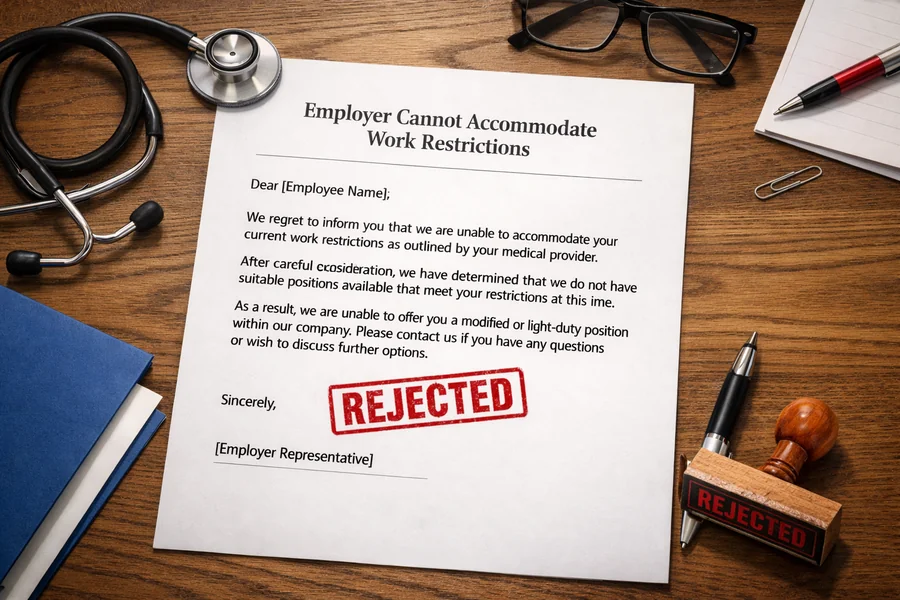
Upon getting an Employer Cannot Accommodate Work Restrictions Letter it is confusing and stressful. This letter is first read by many workers when a medical problem or injury alters their ability to do something safely at work. The phraseology may be definitive and sterile. However, in the majority of situations it becomes a part of a process and not the terminus of your working life. This guideline describes the meaning of the Employer Cannot Accommodate Work Restrictions Letter. It also discusses the reasons why employers send it and the next steps, which normally follow. This is meant to provide you with insight in simple terms so that you can provide answers with certainty.
Understanding an Employer Cannot Accommodate Work Restrictions Letter
An Employer Cannot Accommodate Work Restrictions Letter is a written notice of a company. It informs an employee that the business is unable to accommodate the working boundaries stipulated by a physician or a health practitioner. These constraints can be referred to as work restrictions. They can come in the form of shorter hours with less demanding tasks or not doing some movements. The letter is normally sent to you upon providing medical records to your employer.
Such letter does not necessarily imply that you are being fired. At most of the working places this implies that the employer has read the restrictions and sought amended tasks. Then they came to a decision that there is no fit role that could be offered at this moment. The employer is saying that in their present operations they cannot safely tend to put you into a position that corresponds to your medical needs.
An Employer Cannot Accommodate Work Restrictions Letter may be rather professional in the tone and concise. It can refer to policy safety of the company or operational boundaries. There are also letters describing that the business used alternatives such as light duty or temporary assignment. Others can just mention the conclusion without elaboration.
One should realize that the letter belongs to the employment and disability law procedures in most areas. Reasonable accommodations are a responsibility of the employer. By saying that they cannot accommodate they are stating that it would require serious difficulty or risk on their part to make changes. The validity of such a statement may depend on the facts at the place of work and your position.
Why Employers Send This Letter
There are a number of reasons why employers send an Employer Cannot Accommodate Work Restrictions Letter. One reason is safety. When it comes to activities which require physical work or use of machinery, then the employer might feel that you are not safe or cannot work in that job or pose a danger to others. There is another cause, which is operational need. Certain workplaces are small or very specialized. They might not be having other responsibilities that would suit your constraints.
These decisions may also be affected by cost and staffing. The development of a new post or the elimination of key activities in a job can interfere with business operations. The employers can state that they do not find such changes reasonable. This decision is then written in a form of a letter.
In some cases, the problem is short-term. A business can may be in a position to handle minor constraints but not more critical or long term. Where this occurs the Employer Cannot Accommodation Work Restriction Letters can be seen to include a statement that there is no work available at the moment. This is a phrase that can be reviewed in the future.
There is also a possibility that employers were sending such a letter in order to comply with the legal documentation. The employer in most cases is obliged to respond to the medical notes offered by an employee in writing. The letter is included in an account that they took into consideration the request.
The knowledge of the reason as to why the letter was sent assists you in reacting to the same in a realistic manner. It also changes emotional focus to facts. At that point, you can evaluate how the employer actually does not have alternatives or how more dialogue could help find them.
What It Means for Your Job and Income
Taking an Employer Cannot Accommodate Work Restrictions Letter may influence your employment. In other instances it will result in a temporary leave. At the discretion of the company and local legislation you can be put on unpaid medical leave or long term disability leave. There are other circumstances where the employer can drift towards terminations of the employment relationship.
Even the letter itself does not necessarily amount to termination. It often signals a pause. Employers can hold out until new medical data is available or restrictions are changed. At this period your earnings can be in the form of sick pay insurance or government benefits instead of wages.
This letter can be related to workers compensation claims in case the worker has injury related restrictions. In case the employer is not in a position to offer you an adequate work or job that you can do, you might stay on benefits until you are well or in a state of stability. The letter may be employed to demonstrate that modified duties are not available.
This stage may be an uncertain one emotionally. Routine identity, social connectedness is commonly offered by work. Confidence can be impacted by being deprived of access to your role at least temporarily. That is why it will be useful to consider the Employer Cannot Accommodate Work Restrictions Letter as a part of a more extended process. It leaves doors open as opposed to shutting them all.
How to Respond and What Steps Often Come Next
Once the Employer Cannot Accommodate Work Restrictions Letter is sent the first step is to read it. Record the causes and whether the decision is said to be a temporary one or a permanent one. Find out whether the letter is application of further discussion or medical updates.
Sometimes it is a good idea to talk to your healthcare provider. Inquire as to whether your limitations can alter with treatment or time. The new medical notes may open up new accommodation opportunities. Evident words by a physician will count.
You can also think about a peaceful dialogue with your employer or the human resource department. Enquire as to the options considered. Inquire whether any other schedules were taken into consideration that would put the tasks or the departments. This discussion can bring out the fact that the decision is just final or on scanty information.
Where you are you may have disability or employment rights. These statutes frequently force employers to make sensible accommodations. In case you feel that there is some decent work that you might want to consult a workers rights group or employment professional. They are in a position to tell whether or not the Employer Cannot Accommodate Work Restrictions Letter is legal.
Meanwhile it can also be convenient to investigate personal planning. Research on benefit programs training or temporary employment to suit your skill. Some of them take this time to acquire new skills or look at alternative positions that would suit their health conditions. Reaction does not imply acting in fear. It involves information collection building support and decision-making on the next action depending on your case.
Final Thought
An Employer Cannot Accommodate Work Restrictions Letter may be cumbersome. But it is usually a declaration of what things like now are like and not your worth or what you will be. It is a perception on part of an employer of what can be done in his or her work place at the moment. This will be helped by knowing the purpose of it so as to eliminate some confusion.
This letter will be able to become a turning point. To some it takes one back to work with new responsibilities when restrictions are modified. To others it is a gateway to the advantages retraining or an alternative career path. Although it can be a tough situation it is also eye opening. It informs you of the position and bids you strategize on with enlightenment.
Being updated and posing relevant questions and requesting relevant assistance can make this experience a manageable step. An Employer Cannot Accommodate Work Restrictions Letter is not merely a termination to some tasks. It is also able to be the start of a healthier and more appropriate chapter in your working life.
FAQs
What is an Employer Cannot Accommodate Work Restrictions Letter?
It is a formal notice stating that a company cannot provide work that fits the medical limits given by your healthcare provider.
Does this letter mean I am fired?
Not always. It often means no suitable work is available right now. Some employers place workers on medical leave instead of ending employment.
Can I challenge an Employer Cannot Accommodate Work Restrictions Letter?
In many regions you can ask for clarification or seek advice on your rights. If reasonable accommodations may exist you may be able to request further review.
Should I give my employer new medical notes after this letter?
Yes if your condition changes or a doctor can clarify your abilities. Updated information can sometimes lead to different decisions.
What income options exist if my employer cannot accommodate?
Depending on your situation you may qualify for sick pay disability benefits workers compensation or government assistance programs.
Can I return to work later after receiving this letter?
In many cases yes. If restrictions change or a suitable role becomes available the employer may reconsider placement.