What Happens To Employer Life Insurance After Retirement is a question many employees are only beginning to contemplate towards the end of their working days. Life insurance is usually automatic when it comes to working with your employer. It lags in your benefits package. You are not the person who thinks about it. Retirement transforms that in a very short time. The paycheck stops. The benefit system shifts. Some coverages end. Others change form. It is better to know what is coming so as to keep your family safe and free of surprises.
Group term life insurance is normally employer life insurance. It is made in such a way that it takes care of you when you are working. The cost is often low. There are cases when it is not paid by the employer at all. Sometimes you share the cost. Since it is employment-linked the coverage is not necessarily to accompany you in retirement. That is why it is essential to plan early things.
This guide provides the explanation of what happens to the employer life insurance upon retirement in a human manner. You will know what tends to vary. You will get to know what alternatives can be provided. You will also learn how to decide what is right for you.
Understanding employer life insurance before retirement
To see what becomes of employer life insurance upon retirement it is better to comprehend what this coverage is all about. The majority of group plans by employers are term policies. They offer a certain number of cover usually depending on your salary. Other plans provide an amount of one and two times your annual salary. Others will enable you to purchase additional coverage.
Group term life insurance is easy. No medical examination as a rule. Enrollment is easy. You may have premiums deducted out of your paycheck. The employer makes agreements with the insurer. You belong to a big organization that ensures low expenses.
This kind of insurance is constructed based on active employment. The insurer charges the plan according to the age composition and the occupation of the group. When you are retiring you leave that group. This is the primary cause of changes taking place.
Supplementary life insurance or voluntary life insurance is also provided by employers. Even these are group policies. They may allow higher limits. They can cover spouse or child cover. Even these plans are, in most cases, associated with active employment.
It is simpler to comprehend this structure to find out the reason why retirement causes a shift. The plan was not intended to be a life time personal policy. It was created as a benefit at the workplace.
What usually happens at retirement
What Happens To Employer Life Insurance After Retirement? Life insurance with the employer upon retirement will vary depending on what your employer has and what the plan is. Nevertheless, there are general trends.
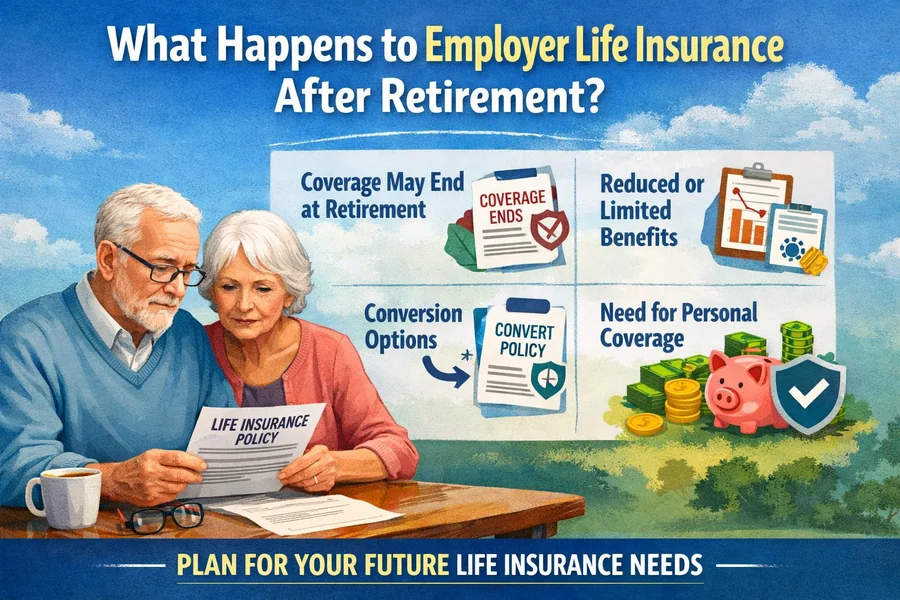
The basic employer paid life insurance terminates in most situations at the time of your retirement. Our coverage can cease on the last day of work. There are plans that stretch it to the month end. Others end it immediately. When it begins to run out the policy ceases to defend you unless you do something.
There are also employers providing low levels of retiree life insurance. This is not so widespread nowadays and yet it exists. It can be a fixed sum such as ten thousand dollars. It may reduce as you age. This is a form of retiree coverage which is normally intended to assist with final expenses and not long term income replacement.
The right to port or convert your coverage is also another similarity. Conversion implies that you can convert your group policy to an individual permanent policy. Portability implies that you can maintain a term cover, thus paying the full premium yourself. These alternatives are time constrained. You can have thirty or sixty days to do it.
When you do not do anything your employer life insurance tends to expire. This is the most important fact of many retirees. The automatic continuity is not provided unless the plan is specifically provided.
Due to this what is being done to the employer life insurance upon retirement is not merely a technical problem. It makes it a personal decision of planning.
Options you may have after retirement
Once you go to retire your benefits office or insurer is expected to give you information. It may arrive in a packet. It may come through meetings. It can be posted in your benefits web site. Your options are contained in that information.
One option is conversion. Conversion involves trading your group term coverage with an individual permanent policy. This may be entire life or universal life. What you are able to convert is normally limited to what you had with the group plan. The good thing is that it does not need any medical scrutiny. It may come in handy in the event that your health has altered.
The downside is cost. Group coverage is usually much cheaper than converted policies. They cost each person depending on his/her age. The premium may be overwhelming to most retirees. Nevertheless, there are certain individuals who will prefer conversion, as it has lifetime coverage, and cash accumulates.
The other choice is portability. Ported coverage is still term insurance. You make premiums to the insurer. The policy remains in place until a given period or till a certain age. The price is generally cheaper than conversion and more expensive than when you were employed. The policy structure is simple because of portability.
Other retirees choose never to have employer coverage again. They instead purchase a new individual policy by a different insurer. This is capable of permitting greater permeability. It is also less expensive when you are healthy. Term and permanent policies may be considered as individual policies. They are designed to suit you and not your former job.
Some employers offer life insurance to retirees automatically. In case this is true with you then you should know how much it changes with age. A lot of the retiree policies decrease at some birthdays. Some end at a set age. This information is useful to understand whether extra coverage is required.
The question then arises on what you want your life insurance to do considering what will become of employer life insurance at retirement. Would you like to defend a husband or wife? Do you want to cover debts. Do you want to leave a legacy. Your response determines your decision.
How to decide what is right for you
It is a personal choice on what to do. There is no single best path. Nevertheless, there are considerate measures that you may take.
Begin by enumerating your financial liabilities at the moment. Do you still have a mortgage. Do you support anyone. Would you like to pay final expenses. These questions establish the amount of insurance that you actually require.
Next look at your health. In case you are in fine health you can be eligible to an affordable individual policy. It may be even cheaper than changing your employer plan. Where conversion can provide peace of mind at a premium price, which is possible where your health is frail.
Then analyze your retirement income. The life insurance premiums shall be taken out of a fixed budget. Ensure that a policy is comfortable. The insurance should not burden your life, it should help.
Do not ignore deadlines as well. The conversion and portability options tend to run out of time. Those doors can be closed by missing the window. Although you may be intending to purchase a new policy it can be prudent to make before retirement. This avoids gaps in coverage.
Discussion with a licensed insurance professional may help. They are able to elaborate on your plan. Outside options can be compared by them. They are able to give you the entire picture.
The deeper issue when people are enquiring about what happens to employer life insurance after retirement is preparation. Early planners experience greater control. Waiting people tend to be in a hurry.
Common misunderstandings to avoid
It has some misconceptions that are problematic.
One is taking the assumption of a free continuation of coverage. Life insurance of most employers does not. Always confirm.
Another is hoping that conversion would be automatic. It is not. You are required to pay and cover premiums.
There are individuals who feel that they do not require life insurance after retirement. For some this is true. For others it is not. One partner can also rely on an income despite the death of another. Final costs may be important. Goals differ.
One wrong perception is that of waiting until retirement to see what options are available. By that time there might be change in health. Deadlines may be near. The sooner the better.
Knowing what will become of the employer life insurance on retirement is one of the things that you need to know when you take charge of your own financial future. It substitutes a surprise with a strategy.
Final Thought
What Happens To Employer Life Insurance After Retirement, The case of employer life insurance at retirement is not an isolated one. It is a transition. An advantage related to your work either ceases or alters. Wherever it goes, you decide what defence suits your new existence.
Retirement means a transition between earning and living on the basis you have made. The change in shift should be reflected in your insurance. It must capture your ambitions your family as well as your tranquility.
By understanding the rules of your plan before hand and experimenting with your opportunities you transform a “to bewilder rather than clarify benefit. That clarity is a blessing to yourself and the people who have to rely on you.
FAQs
Do I automatically keep my employer life insurance after retirement?
In most cases no. Employer life insurance usually ends when active employment ends. Some employers offer limited retiree coverage. You must check your specific plan.
What happens to employer life insurance after retirement if I do nothing?
If you take no action and your employer does not provide retiree life insurance your coverage usually stops. There is often no benefit after that point.
Can I convert my employer life insurance after retirement?
Many plans allow conversion within a short time window. You can turn group coverage into an individual permanent policy without a medical exam. You must apply and pay the new premium.
Is portable life insurance the same as conversion?
No. Portability keeps term insurance and lets you pay for it yourself. Conversion changes it into a permanent individual policy. Each has different costs and features.
Should I buy a new policy instead?
Some retirees choose to buy a new individual policy. This can offer better pricing or more flexibility especially if health is good. It depends on your needs and budget.