When it comes to labeling products quickly and accurately, businesses often have to decide between using a price gun or investing in a digital label printer. Both tools are designed to help businesses label products efficiently, but they work in different ways and serve different purposes.
Understanding how each tool works and where it excels can help businesses determine which solution saves the most time and money.
What is a Price Gun?
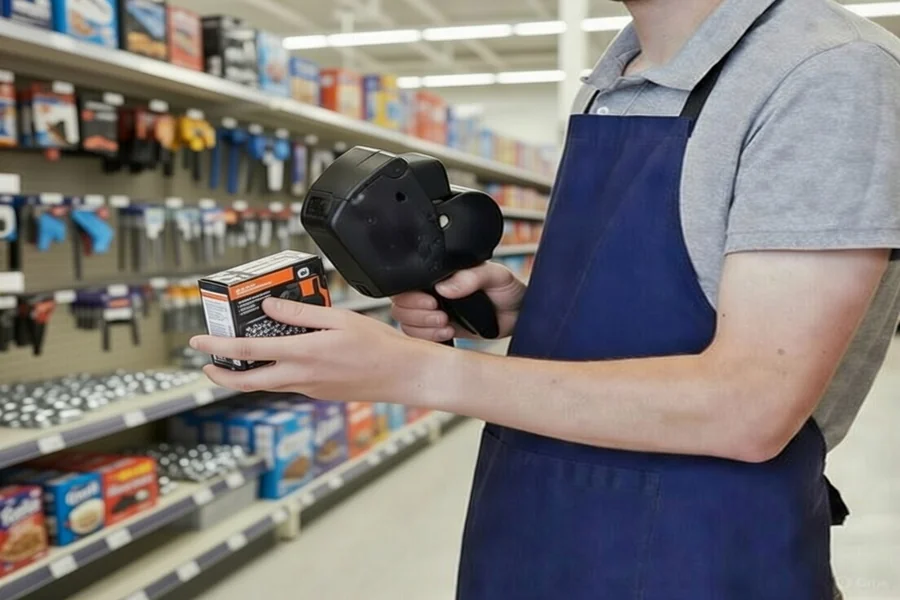
A price gun is a handheld labeling tool that prints numbers or short codes onto adhesive labels when you squeeze the trigger. It’s commonly used in retail stores, grocery shops, warehouses, and resale businesses, allowing employees to quickly load labels, adjust the dial, and tag products.
The Key Benefits of Using a Price Gun
- Ease of use. Staff can learn how to use a price gun in minutes, making it ideal for businesses with high employee turnover or seasonal workers.
- Low up-front costs. Price guns are relatively inexpensive, and replacement label rolls are affordable.
- Fast, on-the-spot labeling. If a price changes or new inventory arrives, employees can quickly label items without setting up a printer or computer.
Limitations of a Price Gun
- They can only print numbers or short codes. With this limitation, price guns cannot include product names, barcodes, logos, or detailed information. Businesses that require more advanced labeling often need additional tools.
- They rely on manual input. Employees must adjust the numbers for each price change, which can be time-consuming and inefficient.
What is a Label Printer?
A label printer is a digital device that creates customized labels using software and printing technology. It’s often connected to computers, point-of-sale systems, or inventory platforms. Unlike a price gun, it can print detailed information such as product names, barcodes or QR codes, SKUs, pricing, and branding, making it a common tool in retail chains, warehouses, logistics operations, and e-commerce businesses.
Advantages of Label Printers
- Businesses can generate labels directly from inventory systems, reducing manual work and improving accuracy.
- Depending on the industry, labels can include branding elements, expiration dates, barcodes, or compliance information.
- Ability to print labels in batches. Printing in large quantities can significantly speed up large inventory labeling projects.
Potential Drawbacks or Label Printers
- The initial cost. Businesses must purchase the printer, compatible labels, and sometimes specialized software, all of which can add up quickly.
- The setup and training period. Staff members may need time to learn how to use the software and maintain the equipment.
Time Comparison: Which is Faster?
The faster option largely depends on how a business labels its products.
A price gun is usually faster for quick manual pricing tasks, since employees can grab the device and label items immediately without a computer or a printer.
Label printers are faster for large batches of products. Instead of manually adjusting numbers, businesses can print hundreds of labels in a single run.
Cost Comparison: Which is More Affordable?
From a short-term perspective, a price gun is typically the more affordable option.
While label printers require a larger investment, they may reduce labor time and improve efficiency for businesses that rely on detailed labeling.
Choosing the Right Tool for Your Business
There is no universal solution that works for every business. Both labeling tools have their place in modern business operations. A price gun remains one of the simplest and most cost-effective tools for quick pricing tasks, while label printers provide advanced features for companies that need automation and customization.
By evaluating factors such as inventory size, labeling requirements, and workflow efficiency, businesses can determine which option truly saves them the most time and money.